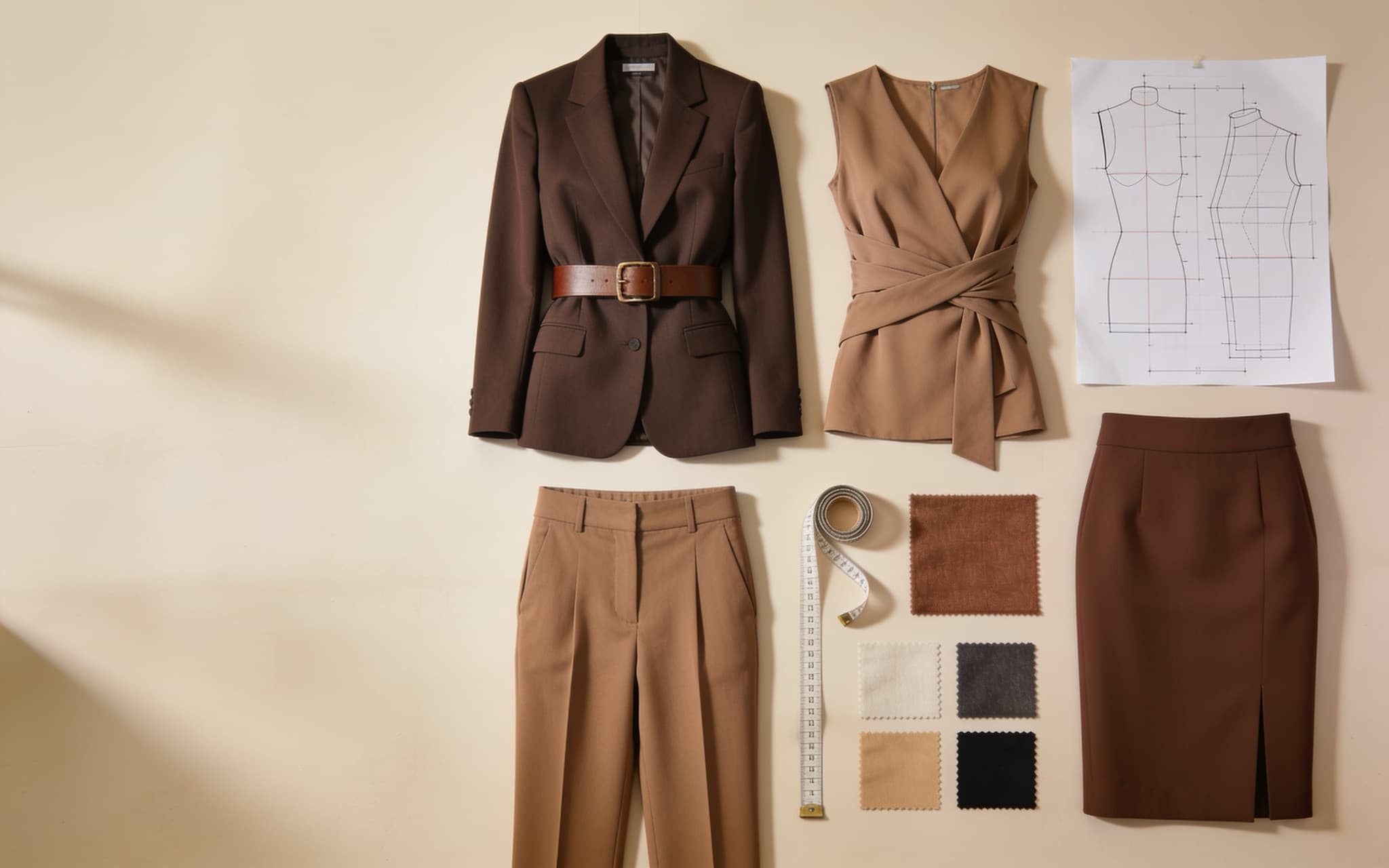
Dressing for your body means working with three relationships instead of a body-type label: where your waist sits and how defined it is, how your shoulder width compares to your hips, and whether you carry length in your torso or your legs. Read those three, then define the waist, keep one long vertical line, and buy for your widest measurement. The rest is preference.
Trends move every season. Your proportions do not. Learn to dress for the body you have, and you stop chasing looks that were never built for it.
Start with balance, not a body-type label
Forget the fruit chart. What matters is balance: how your shoulders, waist, and hips relate to each other, and where your body is widest. You are dressing to create a line the eye can follow, top to bottom, without a snag.
Three questions get you most of the way. Answer them in fitted clothes, in front of a mirror.
1. Where is your waist, and how defined is it? Bend sideways. The crease that appears is your natural waist, and it sits higher than most trouser waistbands. Now judge how far it narrows against your ribs and hips. A pronounced narrowing means belts and wraps do the work for you. A softer line means you build definition with structure: a jacket that nips, a seam, a tuck.
2. Are your shoulders and hips close in width, or is one clearly wider? Stand square and see where each side ends. Close in width means most silhouettes work and you are choosing on taste. A clear difference means you add visual weight to the narrower end: volume on top for wider hips, a fuller leg for wider shoulders.
3. Do you carry length in your torso or your legs? Your wardrobe already told you. If mid-rise trousers sit low and tops come untucked, your torso is long for your height. If high-rise trousers hit near your ribs and shirts bunch when tucked, it is short. This one decides more than people expect, because it sets where your waistband should land.
Your answers point to what to emphasize and what to skim over. They do not sort you into a category, and they change as you do.
Define the waist, and the outfit organizes itself
The waist is the anchor. Mark it, and everything above and below reads as intentional. A wrap dress, a belt over a shift, a high rise with a tucked top: each one draws the eye to the narrowest point and lets the rest fall.
If your waist sits high or low, work with it. A high rise lengthens the leg. A dropped waist suits a longer torso. Fight your real waistline and the clothes look borrowed.
None of this requires cinching. A jacket cut with a waist seam marks the line while hanging open; a half-tuck marks it without a belt. The eye needs to find the narrowest point, not feel it.
Lengthen the vertical line
The eye reads an unbroken line as taller and calmer. You build one with a monochrome column, a long cardigan, a center part, a pointed shoe. You break it, on purpose, when you want to pull attention somewhere: a contrast belt at the waist, a bold shoe at the hem.
One long line, one intentional break.
Color does most of this work. Match your trousers to your shoe and the cut at the ankle disappears. A jacket close in tone to the top under it reads as one piece. Two strong colors meeting at the hip cut a hard line across the widest part of many bodies, worth knowing before you decide you dislike a skirt.
Fit the widest part, tailor the rest
Buy for the largest measurement, then tailor the rest. A blazer that fits your shoulders and hangs open beats one straining at the button. Trousers that clear your hips and take in at the waist beat a size that fits nowhere. A tailor is cheaper than a closet of near-misses.
Shoulders and hips are the expensive alterations. Waists, hems, and sleeve length are cheap. Buy for the parts that cost money to move.
What about the 3-3-3 rule?
Three tops, three bottoms, three pairs of shoes, worn every way they combine. It is a wardrobe exercise, not a styling one, and it works for one reason: nine pieces built on the same proportions combine better than thirty that fight each other.
Proportion is what makes the nine work. Give three bottoms three different rises and the combinations collapse, because every top lands at a different point on your torso. Pick one rise, pick one leg line, and the math starts paying out.
Run the rule after you know your proportions, not instead. On which pieces earn a place, we wrote about which trends are worth your money.
Let the trend earn its place
Once the fit works, a trend is seasoning. Try the color, the print, the silhouette of the moment, and keep what suits your line.
Proportion decides the shape; undertone decides which version of it looks alive on you. Finding your undertone is a shorter job than most people think.
Seeing it on yourself
Reading proportion off someone else is easy. Reading it off yourself is harder, because you have looked at that body your whole life and stopped seeing it years ago.
That is the problem Virtual Stylist was built around: it puts the clothes on your body instead of a model's, so the proportion question answers itself before you spend anything. We wrote about why we render on you and what happens to your photos, the question we get most.
Your proportions first, the occasion second, the trend last. See how that works, or get looks built for your body.